God said to Moses, “I am who I am.” He said further, “Thus you shall say to the Israelites, ‘I am has sent me to you.’” (Note that this is what Jesus quoted in the New Testament that indicated that he claimed to be God.)
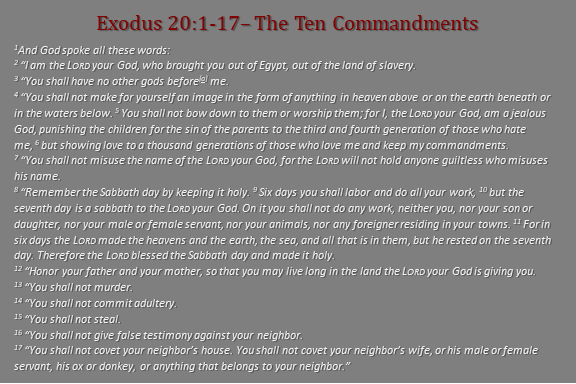
Exodus 20:1-17– The Ten Commandments
1And God spoke all these words: 2 “I am the Lord your God, who brought you out of Egypt, out of the land of slavery. 3 “You shall have no other gods before me. 4 “You shall not make for yourself an image in the form of anything in heaven above or on the earth beneath or in the waters below. 5 You shall not bow down to them or worship them; for I, the Lord your God, am a jealous God, punishing the children for the sin of the parents to the third and fourth generation of those who hate me, 6 but showing love to a thousand generations of those who love me and keep my commandments. 7 “You shall not misuse the name of the Lord your God, for the Lord will not hold anyone guiltless who misuses his name. 8 “Remember the Sabbath day by keeping it holy. 9 Six days you shall labor and do all your work, 10 but the seventh day is a sabbath to the Lord your God. On it you shall not do any work, neither you, nor your son or daughter, nor your male or female servant, nor your animals, nor any foreigner residing in your towns. 11 For in six days the Lord made the heavens and the earth, the sea, and all that is in them, but he rested on the seventh day. Therefore the Lord blessed the Sabbath day and made it holy. 12 “Honor your father and your mother, so that you may live long in the land the Lord your God is giving you. 13 “You shall not murder. 14 “You shall not commit adultery. 15 “You shall not steal.16 “You shall no t give false testimony against your neighbor. 17 “You shall not covet your neighbor’s house. You shall not covet your neighbor’s wife, or his male or female servant, his ox or donkey, or anything that belongs to your neighbor.”
Purpose: To record God’s creation of the world and the beginning of the Hebrew people (Israelites), whom God chose to set apart to worship Him and to be a witness for him in the world.
Note: the names of people in the Bible are descriptive of who they are. God sometimes renamed people – Abram to Abraham, Sarai to Sarah, Jacob to Israel. That is where the name Israel comes from.
High-Level Outline of Genesis
Story of Creation (1:1-2:3)
The Fall and Repercussions (2:4-5:32)
The Flood and its Aftermath (6:1-11:32
The Story of Abraham (12:1-25:18)
The Story of Isaac (25:19-28:9)
The Story of Jacob, Rachel and Leah, and Jacob’s 12 sons (28:10-36:43)
The Story of Joseph (one of Jacob’s 12 sons) and how Jacob’s whole family ended up in Egypt
Genesis 2:24God instituted the marriage relationship. “That is why a man leaves his father and mother and is united to his wife, and they become one flesh.” Note that the word translated “wife” in this verse is אִשָּׁה, phonetically pronounced “ish-shaw.” This word means woman, wife, female. In other words, the same exact word for wife is the same word for female. This is true of the Greek word for woman/wife in the New Testament, as well. Context is the key to understand whether the passage means “woman” or “wife”. The important point is, however, that because the same word is used for both, it means that a wife is always a biological female according to God’s perfect design.
HEBREW ishshah: woman, wife, female Original Word: אִשָּׁה Part of Speech: Noun Feminine Transliteration: ishshah Phonetic Spelling: (ish-shaw’) Definition: woman, wife, female (from Biblehub.com)
GREEK guné: a woman Original Word: γυνή, αικός, ἡ Part of Speech: Noun, Feminine Transliteration: guné Phonetic Spelling: (goo-nay’) Definition: a woman Usage: a woman, wife, my lady.
Genesis 3:20 – Hebrew words are often much more meaningful than we realize and lose some of that meaning when translated into English – Adam and Eve, for example. (from Strong’s Concordance on Biblehub.com)
The Hebrew word translated Adam means “man, mankind”
Original Word: אָדָם Part of Speech: Noun Masculine Transliteration: adam Phonetic Spelling: (aw-dawm’) Definition: man, mankind
The Hebrew word translated Eve means “’life’, the first woman”
Original Word: חַוָּה Part of Speech: Proper Name Feminine Transliteration: Chavvah Phonetic Spelling: (khav-vaw’) Definition: “life”, the first woman
Genesis 9:5-6 God demands an accounting for taking anyone’s life. God makes it abundantly clear in these verses that no one is to take another life. Since he also has said that he personally has knit us together in our mother’s wombs, that would include human fetuses. “For you created my inmost being; you knit me together in my mother’s womb. I praise you because I am fearfully and wonderfully made; your works are wonderful, I know that full well. My frame was not hidden from you when I was made in the secret place, when I was woven together in the depths of the earth. Your eyes saw my unformed body; all the days ordained for me were written in your book before one of them came to be.” (Psalm 139:13-16)
Genesis 9:7-17 God’s Covenant with Noah – the rainbow. God covenants with Noah never again to destroy all living things by flood. This is a unilateral covenant – God requires nothing of Noah. The sign of the covenant God gives is the rainbow. So whenever you see a rainbow, remember what it truly stands for.
Genesis 12:1-3 God makes a promise to Abram. Here God calls Abram and tells him to leave everything and go to a country that God will show him. God makes a promise to Abram that he will make him into a great nation and bless him and that all the peoples of the earth will be blessed through him. God also says that he will bless whoever blesses Abram and curse whoever curses Abram. This promise has never been rescinded and is in effect today.
Clearly God is alluding to the future Messiah, Jesus. But he has blessed all the peoples of the earth through the Jews in other significant ways through their contributions to medicine, science, technology, the arts, and every category of human endeavor. (For specifics, see https://www.jinfo.org/.)
Genesis 45:5-8a It was God who sent Joseph to Egypt.“Then Joseph said to his brothers, “Come close to me.” When they had done so, he said, “I am your brother Joseph, the one you sold into Egypt! And now, do not be distressed and do not be angry with yourselves for selling me here, because it was to save lives that God sent me ahead of you. For two years now there has been famine in the land, and for the next five years there will be no plowing and reaping. But God sent me ahead of you to preserve for you a remnant on earth and to save your lives by a great deliverance. “So then, it was not you who sent me here, but God.”
Genesis 49:10-12 Jacob’s blessing of his son, Judah, is a messianic prophecy about the Messiah being from the tribe of Judah.
10 The scepter will not depart from Judah, nor the ruler’s staff from between his feet, until he to whom it belongs shall come and the obedience of the nations shall be his. 11 He will tether his donkey to a vine, his colt to the choicest branch; he will wash his garments in wine, his robes in the blood of grapes. 12 His eyes will be darker than wine, his teeth whiter than milk.
This week narrates the continuing journey to the Promised Land, the giving of the 10 Commandments, and specifications for the Tabernacle and priests.
Key people this week:
Moses
Aaron
Jethro, Moses’ father-in-law
Joshua
Key events this week:
The people continue to grumble when they come up against a seeming obstacle – this time a lack of food – as if God wouldn’t provide. They continue to look back to their life in Egypt, forgetting the harshness of their slavery, and remembering only the good things about it. Not trusting God will be a continuing theme. Paul said that these things were written “to teach us, so that through the endurance taught in the Scriptures and the encouragement they provide we might have hope,” (Romans 14:4).
God provided quail to eat in the evening and manna in the morning with instructions to gather only what they needed for that one day except the 6th day when they could gather enough for the Sabbath, as well.
The Sabbath is instituted.
God provides water from a rock.
The Israelites, led by Joshua, defeat the Amalekites – winning as long as Moses kept his hands up.
Jethro, Moses’ father-in-law advises Moses to set up a hierarchy of judges over the people, bringing only the difficult cases to Moses, so he would not be worn out.
God gave the Law, the 10 Commandments, written on tablets of stone to Moses on Mt. Sinai.
God provided additional instructions on idols, altars, Hebrew servants, personal injuries, protection of property, social responsibility, justice and mercy, the Sabbath.
God instituted three annual festivals. These are the three festivals of the year that all Hebrew men had to appear before the Lord – the ones that later they would have to go to Jerusalem to celebrate.
Festival of Unleavened Bread (Immediately follows Passover),
Festival of Harvest (first fruits),
Festival of Ingathering (end of harvest).
God specifies the borders of the Promised Land (Ex. 23:31).
God confirms the Covenant.
God provides instructions for constructing the Tabernacle and its furnishings, including the Ark of the covenant.
Aaron and his sons set apart and consecrated as priests plus description of the priestly garments.
The infamous Golden Calf incident. Moses was so mad that he smashed the tablets with the 10 Commandments. [Did I select the photo of the Golden Calf on Wallstreet on purpose? Yes.]
Moses pitches the “tent of meeting” outside the camp for anyone who wanted to inquire of the Lord.
Moses asked the Lord, “Show me your glory,” (Ex. 33:18).
Moses goes up on the mountain again and God gives him new stone tablets.
God chose men with great skill to build the tabernacle – Bezalel and Oholiab – and the tabernacle was constructed.




 A Pilgrim's Journey